 AI-First Culture
What is API-Led Connectivity? A Guide for Enterprise Teams
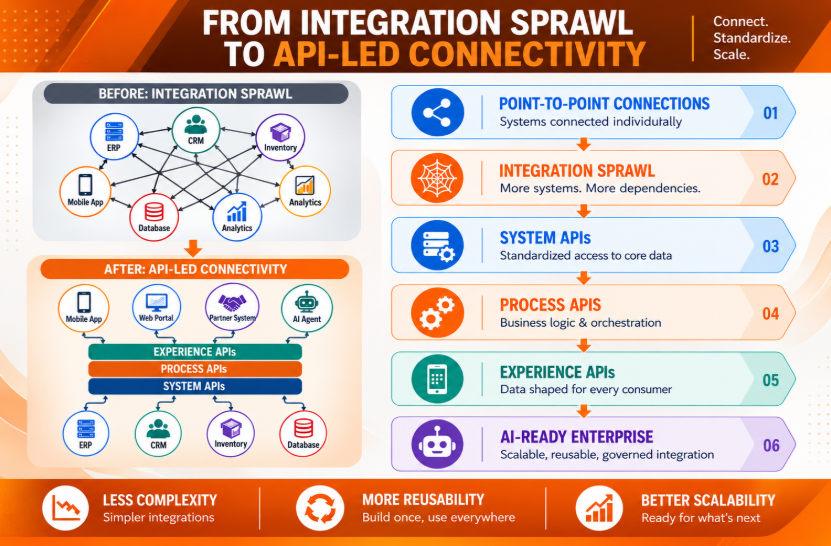
What's API-led connectivity? In simple words, it's an integration method developed by MuleSoft that sorts out a firm's APIs into three designated levels: System, Process, and Experience, instead of linking systems one connection at a time by means of establishing a separate link with every system. For instance, there's no need to build a specific link every time a particular ERP must connect to a certain CRM, or a mobile application must communicate with an inventory database. Each system produces a reusable API with a defined task.
Why Enterprises Are Rethinking Integration in 2026
Most organizations do not end up with fragile integration by choice. It happens gradually. A CRM gets connected directly to an ERP to solve one urgent problem. Then the ERP gets wired to a mobile app for another. Then a reporting tool gets bolted onto three different systems at once. Each shortcut solves an immediate need, but every direct connection is another dependency, and eventually a small change in one system breaks several others downstream in ways nobody fully mapped out in advance. This pattern, sometimes called integration sprawl, is exactly what API-led connectivity was designed to prevent.
The pressure to fix this is particularly acute across the GCC and wider MENA region right now. National digital transformation programs, including Saudi Arabia's Vision 2030, the UAE's various digital government and "paperless government" strategies, Qatar's National Vision, and similar initiatives elsewhere, are pushing banks, telcos, government entities, and large conglomerates to connect legacy core systems with new mobile, web, and increasingly AI-driven experiences at a pace few of these systems were originally built for. For enterprises looking to navigate these integration challenges locally, working with UAE regional partners can provide the expertise needed to address regional requirements and complex MuleSoft environments. A recent Forbes Councils piece on the challenge of scaling API delivery makes a related point: building individual APIs was never the hard part. The real difficulty shows up once an organization tries to scale API delivery across many teams without duplicated effort or unclear ownership.
The Three Layers of API-Led Connectivity
Each layer in this architecture has a distinct, non-overlapping responsibility, which is what keeps the whole system maintainable as it grows.
| Layer | Its Role |
|---|---|
| System APIs | Connect directly to core systems of record, such as an ERP, CRM, or database, and expose their data in a standardized format without changing the underlying system |
| Process APIs | Orchestrate and combine data from one or more System APIs to carry out a specific business process, encapsulating logic that does not belong in the raw data layer |
| Experience APIs | Shape and format data specifically for the consumer requesting it, whether that is a mobile app, a web portal, a partner system, or increasingly, an AI agent |
Because each layer only depends on the layer beneath it, a system underneath can change, be replaced, or be upgraded without forcing a rebuild of everything connected above it. That separation is the core engineering benefit the rest of this guide builds on. It also matters for a very practical regional reason: many MENA enterprises operate core systems on-premise or in-country to meet data residency requirements, while wanting the flexibility to run newer digital experiences in the cloud. A layered architecture lets those two worlds coexist without forcing a single deployment model on everything.
Key Benefits of API-Led Connectivity
Once the three layers are in place, a handful of concrete advantages tend to follow.
-
Reusability: a System API built once for a CRM can be called by multiple Process APIs across different projects, instead of being rebuilt for every new integration need
-
Faster development cycles: teams building a new digital experience can compose existing APIs rather than starting integration work from zero
-
Reduced blast radius: a change to one system's underlying technology stays contained within its System API layer instead of cascading through every connected application
-
Centralized governance: API gateways and access policies sit at defined layer boundaries, making security and compliance easier to enforce consistently
-
Operational visibility: centralized API management gives teams real insight into usage patterns, performance, and where failures are actually occurring
Data Residency and Regulatory Considerations Across the Region
API-led connectivity is not just an engineering pattern in MENA. It is increasingly a compliance enabler. Regulations such as Saudi Arabia's Personal Data Protection Law (PDPL) place growing requirements on how personal data is collected, processed, shared, and transferred across systems. A well-governed System API layer gives compliance and security teams a clear, auditable boundary by ensuring that data leaving a core system passes through a defined and monitored interface rather than undocumented point-to-point integrations. This approach improves visibility, strengthens data governance, and makes it easier to demonstrate compliance during audits while reducing the impact of regulatory changes on the broader integration landscape.
API-Led Connectivity and the Rise of AI Agents
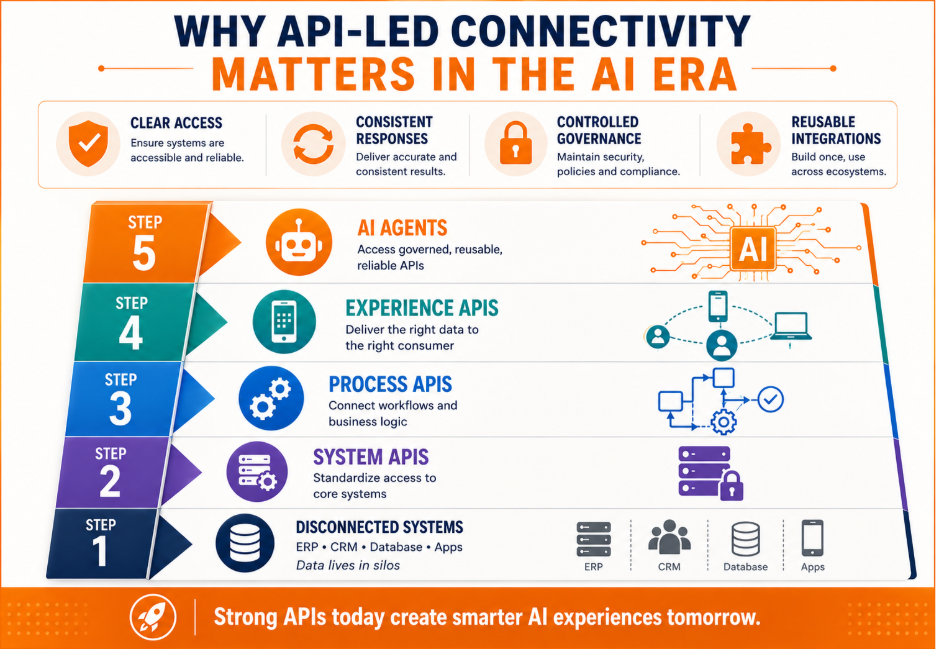
This architecture is getting renewed attention in 2026 for a reason that has little to do with mobile apps or web portals. AI agents do not read a database schema or infer intent the way a human developer might. They call an API, and if that API is really a fragile, undocumented point-to-point connection wearing an API label, the agent inherits every bit of that fragility, inconsistent error handling, no versioning, no clear failure behavior, and acts on top of it autonomously. McKinsey's own research on enterprise architecture for the agentic era describes the shift enterprises now face as building toward a composable set of interoperable building blocks rather than a rigid, monolithic system, which is functionally the same principle API-led connectivity has applied to integration for close to a decade.
This matters directly for MENA organizations investing heavily in AI as part of national strategies, from Saudi Arabia's and the UAE's AI ambitions to sector-level pushes in banking, telecom, and government services. Enterprises that already have a clean, layered API architecture are discovering they are far better positioned to let AI agents safely call Process and Experience APIs than organizations still running on ad hoc, undocumented connections between systems.
"AI scales fastest in organizations where data flows through governed APIs, not disconnected systems."
Getting Started With API-Led Connectivity Services
Adopting this approach works best as a deliberate sequence rather than an all-at-once rebuild.
-
Start by identifying your core systems of record, often core banking platforms, ERPs, or telecom OSS/BSS systems in this region, and build System APIs for the two or three most frequently accessed ones first, rather than attempting to map the entire enterprise at once.
-
Define ownership for each API layer clearly, since unclear responsibility for a Process API is one of the fastest ways architecture governance breaks down as the network grows, particularly in organizations spanning multiple GCC markets with separate local teams.
-
Choose an integration platform built specifically to support the three-layer model rather than forcing a general-purpose tool to approximate it, and confirm its deployment options align with your data residency obligations.
-
Document each API's contract, versioning policy, and expected behavior before exposing it to other teams, so consumers are not left guessing when something changes.
-
Treat the rollout as incremental, adding new System and Process APIs as real business needs surface rather than pre-building a network nobody has asked for yet.
Many enterprises reach this stage and decide to bring in dedicated API-led connectivity services rather than building the governance model entirely in-house, particularly when legacy systems, multi-country regulatory requirements, and Arabic/English bilingual digital experiences add complexity a small internal team was not resourced to handle alone. Working with MuleSoft experts can help enterprises design the right API architecture, establish governance, and accelerate implementation across complex environments.
Common Mistakes to Avoid
A few recurring missteps tend to undermine this architecture even after teams commit to it.
-
Skipping the Process layer entirely and letting Experience APIs call System APIs directly for convenience, which quietly reintroduces the same tight coupling the architecture was meant to eliminate
-
Treating API documentation as optional, which forces every new consuming team to reverse-engineer behavior instead of building against a clear contract
-
Building System APIs around a single consuming application's needs rather than a truly reusable, generic data shape, which limits reuse before the API has even shipped
-
Underinvesting in API gateway governance, leaving access control and monitoring as an afterthought rather than a designed part of the architecture from day one
Conclusion
The concept of API-led connectivity is not a mere fad in the field of architecture. It is a way to address the challenge of systems needing to interact in a rapidly expanding economy with limited personnel capable of bridging the gaps between them. For enterprises across Saudi Arabia, the UAE, Qatar, and the broader MENA region, this challenge is amplified by ambitious national digital and AI agendas, cross-border operations, and evolving data protection laws. By applying the three-layer architecture, organizations can reduce this complexity and reuse the same integrations repeatedly rather than building them from scratch each time. Businesses across the region revising their approaches to integration in 2026 are increasingly convinced that the real question is not whether to adopt the API-led connectivity framework, but how quickly they can progress from sporadic connections to a structured integration strategy.
Build Smarter Integrations
Connect systems faster, reduce complexity, and create an API foundation ready for AI.
Talk to our MuleSoft experts.Frequently Asked Questions
This is a type of integration architecture that separates APIs into three parts: System, Process, and Experience, instead of plugging systems directly together.
The method entered the public consciousness through the work of MuleSoft, which was based on how architecture works in the business world and is now widely used in enterprise integration, including by banks, telcos, and government entities across the GCC.
A System API deals with the core system of record, while the Process API fetches or pulls information from System API(s) and performs a business operation.
It delivers the most value for organizations managing multiple systems and integrations, so smaller businesses with only one or two core systems may not need the full three-layer model yet.
AI agents interact with enterprise systems by calling APIs, so a clean, well-governed layered architecture gives agents a reliable, documented path to data instead of inheriting the fragility of undocumented point-to-point connections.
Yes. Because System APIs create a defined, monitored boundary around core systems, they make it easier to control where data flows and to demonstrate compliance with regulations such as Saudi Arabia's PDPL or the UAE's data protection law, compared with untracked point-to-point integrations.
Keep reading
Salesforce Data Cloud and Agentforce: Building AI Agents With Connected Customer Data
Agentforce Implementation: Architecture, Integrations and Enterprise Requirements
How to Identify the Right AI Opportunities in Your Salesforce Environment
Ready to build smarter? Let's talk.
Our experts are ready to help you turn ideas into production-ready AI, cloud and digital solutions.
Get In Touch →Let's Discuss Your Growth Strategy
Let's discuss how we can help you accelerate growth, improve efficiency, and drive real business outcomes.