 AI-First Culture
From AI Assistants to AI Agents: How to Put AI to Work with Salesforce
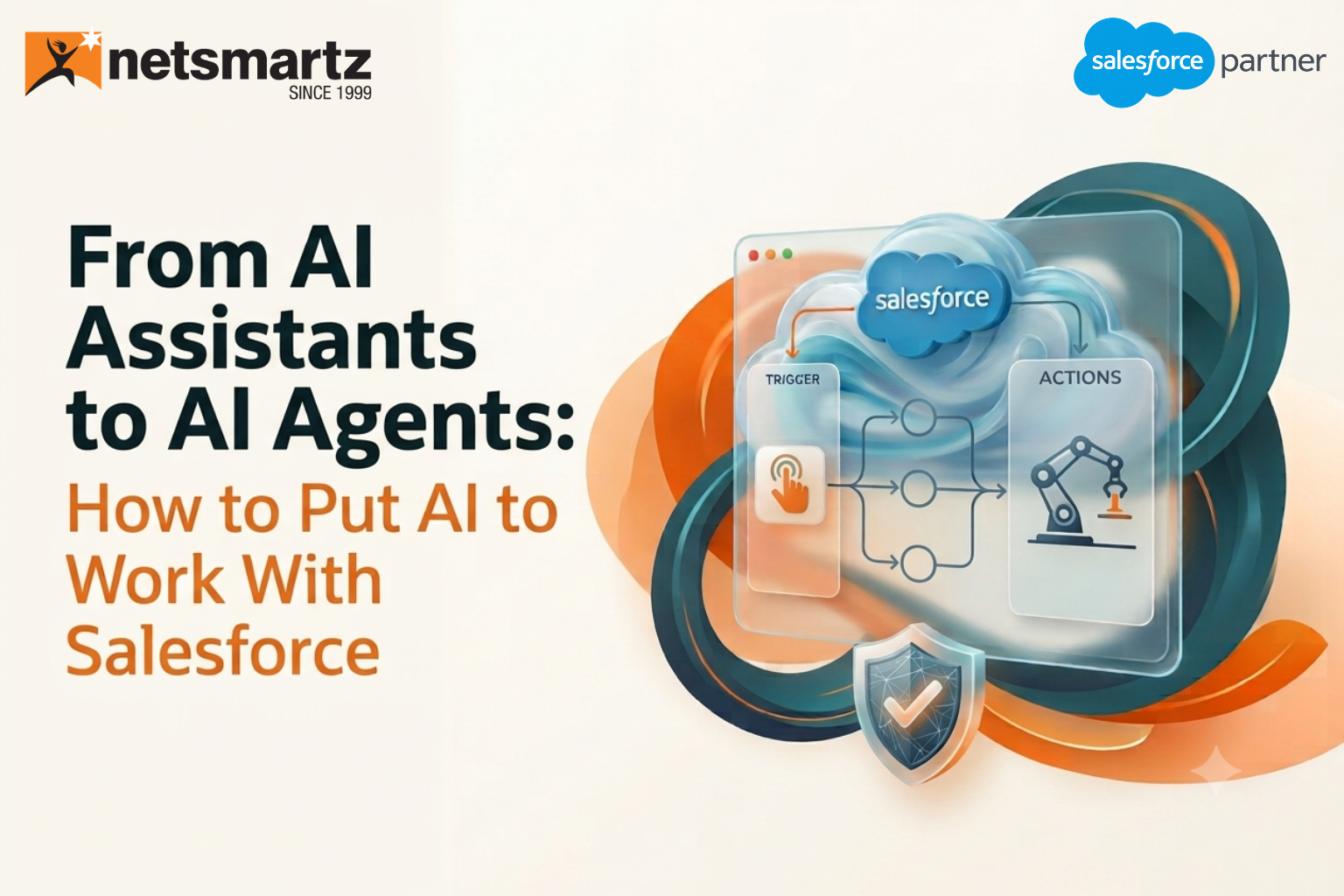
"AI creates value when it stops answering questions and starts completing work."
AI adoption is accelerating across MENA, and most organizations are already familiar with AI assistants. But AI is moving past answering questions and generating content. Businesses are starting to explore AI that can reason, make decisions, and complete tasks. The future of AI isn't only about helping employees. It's about helping execute the work. For existing Salesforce customers, that shift may be closer than it looks. This guide explains the shift in plain business terms.
Why AI Assistants Are No Longer Enough
AI assistants do plenty well. They answer questions, generate content, summarize information, and offer recommendations. For one person at a desk, that's a real gain. The trouble starts when you try to scale them. Picture a sales manager asking an assistant to summarize the pipeline. It does that well. But someone still has to reassign the stalled deals, chase the follow-ups, and update the records. That gap between advice and action is where the value leaks out.
- They can't complete an end-to-end task
- They still need a human to step in
- Their ability to execute workflows is limited
- They have little awareness of how your business processes actually run
As organizations scale AI, they need more than recommendations. They need action. The market is heading the same way: Gartner predicts that 40 percent of enterprise applications will include task-specific AI agents by the end of 2026, up from less than 5 percent in 2025, with assistants acting as the precursor.
What Is an AI Agent?
The simplest way to picture an AI agent is as a colleague who doesn't just tell you what to do but gets on with it. An agent can:
- Understand objectives
- Analyze context
- Make decisions
- Trigger actions
- Complete multi-step tasks
| What it does | AI assistant | AI agent |
|---|---|---|
| Role | Suggests what to do | Helps do the work |
| Scope | A single question or request | A multi-step task from goal to outcome |
| Human involvement | Needed at every step | Stays in the loop for exceptions |
| Output | Advice or content | Completed action inside your systems |
A useful test is to ask who does the last step. If a person still has to copy the answer into the CRM, you're looking at an assistant. If the system updates the record itself, you're closer to an agent.
In practice, that means qualifying leads, handling service requests, updating CRM records, and coordinating workflows. An agent stops being a chat window and starts acting as an active participant in business operations.
Why Agentic AI Is Gaining Attention Across MENA Enterprises
Several regional forces are pushing it up the agenda:
- Digital transformation initiatives
- Rising customer expectations
- Pressure to improve productivity
- Demand for operational efficiency
- Growing AI investment across the UAE and KSA
None of these is new on its own. What's new is that the technology can now carry part of the load, which matters in markets where teams are lean and growth targets are not. That makes the cost question hard to ignore.
Vendors are responding. In February 2025, Salesforce announced a $500 million investment in Saudi Arabia, pointing to growing Agentforce adoption among businesses there. It also said it would bring Hyperforce to the Kingdom and keep expanding Arabic language support. Hyperforce already supports UAE data residency.
Behind all of this sits a plain business challenge: organizations want to scale operations without scaling costs. Agentic AI offers a way to get there by automating work, not just providing insights.
Key Characteristics of AI Agents
Agents differ from assistants in five ways that matter for day-to-day operations.
- Reasoning: They understand context, analyze information, and evaluate options.
- Decision-making: They prioritize actions, recommend next steps, and respond dynamically.
- Task execution: They complete multi-step workflows, trigger actions automatically, and reduce manual intervention.
- Continuous learning: They improve through feedback and adapt as business needs change.
- Human-agent collaboration: They work alongside employees, escalate when required, and support decisions.
Take escalation. A good agent knows when it's out of its depth and hands the case to a person with the context attached. That single behavior is what makes agents safe enough for customer-facing work.
The last point is the one leader worry about, so it's worth saying plainly. The goal isn't to replace people. It's to help teams operate more efficiently.
Where AI Agents Can Create Business Value Today
You don't need to invent new processes. Start with the work your teams already do in Salesforce.
Sales
In sales, the early wins usually come from speed, because an agent never forgets a follow-up.
- Lead qualification
- Opportunity prioritization
- Follow-up recommendations
- Pipeline management
Customer Service
- Case routing
- Case summarization
- Customer assistance
- Knowledge retrieval
For service teams in MENA, handling cases in both Arabic and English is often where an agent earns its keep first. A case that arrives in Arabic shouldn't need a manual translation step before it can be routed, summarized, and answered.
Marketing
- Lead nurturing
- Audience insights
- Campaign recommendations
Operations
Approval chains are a quiet favorite, since they eat hours without anyone noticing.
- Workflow coordination
- Internal support requests
- Approval processes
The biggest opportunities are often hiding in business processes that already run on Salesforce, which is good news if you're wondering where to begin.
Building the Foundation for Agentic AI Success
An agent is only as good as the ground it stands on. Four things need to be solid:
- Trusted data: Connected customer information, unified business data, and fewer silos.
- Process readiness: Standardized workflows, clear business rules, and defined ownership.
- Governance and security: AI oversight, compliance controls, and responsible AI practices.
- Business alignment: Clear use cases, measurable outcomes, and executive sponsorship.
Most of the effort here isn't glamorous. It's cleaning duplicate records, writing down business rules that live in someone's head, and deciding who owns what.
Governance needs extra attention in this region. Both the UAE and Saudi Arabia have personal data protection laws, and many organizations must think about where data is stored. It also pays to be realistic: Gartner has warned that more than 40 percent of agentic AI projects could be canceled by the end of 2027 because of rising costs, unclear business value, or weak risk controls. Strong foundations beat advanced technology on its own.
Common Myths About AI Agents
| Myth | Reality |
|---|---|
| AI agents will replace employees | They support and augment teams. |
| AI agents require replacing existing systems | Most organizations can extend their current Salesforce investments. |
| AI agents are only for large enterprises | Organizations of different sizes can begin with targeted use cases. |
| AI agents deliver instant results | Success depends on readiness, governance, and workflow maturity. |
The last myth trips up more projects than the other three combined. A pilot that goes live in weeks can still take months to settle into everyday use. Myth two is worth repeating for Salesforce customers: you're extending a CRM you already trust, not replacing it.
How to Start Your Agentic AI Journey
Six steps keep the journey manageable. Treat them as a loop, since what you learn from a pilot will often send you back to the data.
- Assess current Salesforce maturity. Know where you stand before you pick a use case.
- Identify repetitive and high-impact processes. These are your likeliest early wins.
- Evaluate data readiness. Agents can't act well on records they can't trust.
- Prioritize AI agent use cases. Choose a small, ranked list.
- Launch controlled pilots. Keep them small enough to learn from.
- Scale successful initiatives. Expand only what has proven its value.
Many organizations discover readiness gaps along the way. This is where Salesforce CRM consulting like Netsmartz can help organizations assess their current environment, prioritize use cases, improve data readiness, and build a practical roadmap for AI adoption. For regional rollouts, it also helps to bring compliance and governance into the process early.
Conclusion
AI is evolving from assistance to action. Organizations that understand the shift to agentic AI will be better positioned to improve efficiency and customer experiences. The most successful implementations start with strong data, mature processes, and clearly defined business goals. Existing Salesforce customers already have a foundation that can support this evolution. Working with experienced Agentforce experts can help organizations turn that foundation into practical AI use cases without starting from scratch. None of this asks you to start over. It asks you to look at the work you already do and decide where an agent could carry part of it.
Put AI to Work Inside Salesforce
Transform repetitive tasks into automated workflows and empower your teams with AI agents that deliver real business outcomes.
Get in Touch.FAQs
An assistant suggests what to do, while an agent helps do the work.
They use your CRM data and rules to act on tasks, escalating when needed.
AI that can reason, decide, and complete multi-step tasks toward a goal.
Assess maturity, clean up data, standardize workflows, and set clear governance.
Accurate, connected, and accessible customer and business data with minimal silos.
Keep reading
Salesforce Data Cloud and Agentforce: Building AI Agents With Connected Customer Data
Agentforce Implementation: Architecture, Integrations and Enterprise Requirements
How to Identify the Right AI Opportunities in Your Salesforce Environment
Ready to build smarter? Let's talk.
Our experts are ready to help you turn ideas into production-ready AI, cloud and digital solutions.
Get In Touch →Let's Discuss Your Growth Strategy
Let's discuss how we can help you accelerate growth, improve efficiency, and drive real business outcomes.